SolaX HS51 Battery
The SolaX HS51 is a home battery built from 5.1 kWh modules stacked into a tower. It runs through a SolaX hybrid inverter: the X1-VAST for single phase homes, or the X3-HYB-G4 PRO or X3-ULTRA for three phase. Add SolaX's Binary charger and a car that supports vehicle-to-load can help power the house too.
 10.2 – 66.5 kWh6.1 – 39.9 kW10-year warranty
Key Features
- Built from 5.1 kWh modules, two to thirteen in one system: 10.2 to 66.5 kWh. One tower holds up to ten modules (51.2 kWh). SolaX's datasheet lists the bigger sizes as two towers and marks multi-tower setups as coming soon, so ask us if you need more than one tower
- SolaX's datasheet gives usable energy at 90% of that (9.1 kWh from 10.2 kWh). The inverter and how it is set up decide the final figure
- The more modules, the more power: rated from 6.1 kW with two modules to 39.9 kW with thirteen, though in practice the inverter sets the limit
- Runs with SolaX hybrid inverters: the single phase X1-VAST and the three phase X3-HYB-G4 PRO and X3-ULTRA. SolaX says an X1-VAST takes up to eight HS51 modules (40.9 kWh)
- Keeps the power on in a blackout through the SolaX inverter, which switches over in under 10 milliseconds. With an X1-VAST, SolaX designs the system to back up the whole home (up to 63 A)
- LFP (lithium iron phosphate) cells, rated for more than 6,000 cycles
- IP66 rated, with built-in aerosol fire suppression
- Add modules later: they stack with plug and play wiring, and SolaX's optimiser version of the module (TB-HS51O) is built to let new modules work alongside older ones
- Every tower is 600 mm wide and 376 mm deep. Its height depends on the modules: 621 mm with two, 1,293 mm with six and 1,965 mm with ten
- Every size from 10.2 to 66.5 kWh is on the Clean Energy Council's approved battery list
- 10-year SolaX warranty. For everyday solar storage and backup, SolaX promises it keeps at least 70% of its energy at 10 years, up to 6,000 cycles
How the SolaX system works
A SolaX battery system has two main parts, plus one you can add. The HS51 battery stores your solar. The SolaX hybrid inverter is the brain: it runs your solar panels, the battery and your backup power from one box. SolaX's Binary charger, if you want it, brings your car into the same system.
Which inverter depends on your power supply. A single phase home gets the X1-VAST (5 to 10 kW). A three phase home gets the X3-HYB-G4 PRO (4 to 15 kW) or, for bigger properties, the X3-ULTRA (15 to 30 kW). We check your switchboard before we quote.
Day to day, your solar runs the house first, then charges the battery, and only then sends what's left to the grid. In the evening the battery runs the house until it reaches the minimum level set on the inverter, and then the grid takes over. That is SolaX's everyday mode, which it calls Self use. There are others, such as a Backup mode that holds more charge in reserve.
SolaX's Binary charger charges the car from your solar. If your car supports vehicle-to-load (V2L), it can also send power from the car back through the SolaX inverter to run the house, including in a blackout. SolaX calls this vehicle-to-home. It works with the X1-VAST and X3-HYB-G4 PRO. For the X3-ULTRA, SolaX says support is on the way, so ask us where it's up to.
The car can only back up the house while it's home and plugged in, and the car decides how much power it can give (the charger passes up to 7 kW to the inverter). So whether you also want a home battery depends on when your car is away. We'll go through it with you before you decide.
What happens in a blackout
When the grid drops out, the SolaX inverter switches to backup by itself in under 10 milliseconds, which SolaX calls UPS-level, so the power stays on. On backup, your solar runs the house first, any extra charges the battery, and the battery covers the rest.
What stays on depends on how it's wired. SolaX's Australian wiring guides show two ways: whole-home backup, where the whole switchboard stays on, and partial backup, where only the circuits you choose do. Either way, the inverter can supply up to its own size at once (about 10 kW on a 10 kW X1-VAST, for example), and twice that for 10 seconds so fridges and air conditioners can start. If the house asks for more, the inverter reports an overload until something is switched off.
The battery keeps a reserve. In the everyday Self use mode, SolaX's manuals say that once the battery has run down to its minimum and there is no sun, the inverter won't switch to backup if the grid then fails. Backup mode holds more charge back for exactly that reason, and SolaX suggests switching to it ahead of an outage you can see coming, such as a big storm.
If a blackout outlasts the battery, it stops at its minimum level. When the sun comes back, solar recharges the battery and the backup starts again by itself. One firm rule from SolaX: medical equipment must not be connected to the backup supply, so don't rely on it for life support or medical devices.
The warranty, in plain English
SolaX gives the HS51 a 10-year warranty from the day it's installed (or 129 months from when it was made, if that comes first). For everyday solar storage and backup, SolaX promises it will still hold at least 70% of its energy after 10 years, for up to 6,000 cycles. A cycle is one full charge and discharge. The SolaX inverters get 10 years too.
SolaX's terms ask for the system to be registered with SolaX once it's commissioned, and an unregistered system is one of the exclusions they list. These are SolaX's terms for products installed in Australia from 1 February 2025.
HS51 sizes at a glance
Each module adds 5.1 kWh. The kWh figure is how much energy the battery holds; the kW figure is how much power it can give at once.
| Modules | Battery size | Usable energy | Rated power | Height |
|---|---|---|---|---|
| 2 | 10.2 kWh | 9.1 kWh | 6.1 kW | 621 mm |
| 3 | 15.3 kWh | 13.7 kWh | 9.2 kW | 789 mm |
| 4 | 20.4 kWh | 18.3 kWh | 12.3 kW | 957 mm |
| 5 | 25.6 kWh | 23.0 kWh | 15.4 kW | 1,125 mm |
| 6 | 30.7 kWh | 27.6 kWh | 18.4 kW | 1,293 mm |
| 7 | 35.8 kWh | 32.2 kWh | 21.5 kW | 1,461 mm |
| 8 | 40.9 kWh | 36.8 kWh | 24.6 kW | 1,629 mm |
| 9 | 46.0 kWh | 41.4 kWh | 27.6 kW | 1,797 mm |
| 10 | 51.2 kWh | 46.0 kWh | 30.7 kW | 1,965 mm |
| 11 | 56.3 kWh | 50.6 kWh | 33.8 kW | Two towers |
| 12 | 61.4 kWh | 55.2 kWh | 36.9 kW | Two towers |
| 13 | 66.5 kWh | 59.8 kWh | 39.9 kW | Two towers |
Usable energy is SolaX's figure at 90% depth of discharge (how far the battery is run down). Rated power is what the battery can charge and discharge at; in practice the inverter sets the limit. Every tower is 600 mm wide and 376 mm deep.
An X1-VAST takes up to eight modules (40.9 kWh), SolaX says. The X3-HYB-G4 PRO takes two to thirteen on each battery port, and the X3-ULTRA needs at least three. Sizes over ten modules are two towers, which SolaX's datasheet marks as coming soon.
Source: SolaX HS51 datasheet (Australia) V1.92; SolaX X1-VAST + HS51 article (20 Mar 2026); SolaX X3-HYB-G4 PRO and X3-ULTRA datasheets (Australia).
Price
Contact us for a quote
Every battery is sized to your home, so we price it on a written quote. Our quotes include GST.
Contact us for a quote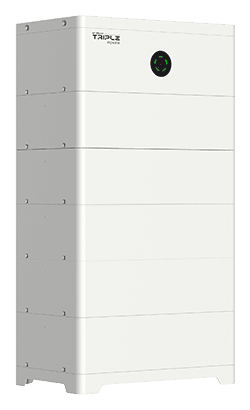
Questions about the SolaX HS51
Interested in SolaX HS51?
Start a quote with this battery already selected, and we'll come back with a written quote designed around your usage and budget.
Get a Free Quote